Interview with Factor, RQ Hartford Winner and Best of Master Yi
Following his victory at Hartford, Factor breaks down battlefield selection, mulligan strategy, mind gaming the opponent, and the importance of testing bad matchups in casuals.
Flavinger·July 7, 2026·20 min read
AMY: I met you right before your Top 4 match. I saw you sitting alone there and thought, “He looks really fun to talk to.” You have a nice aura, and I was glad to catch you.
FACTOR: I remember we talked for a second. I’m so happy that my aura was good because I was obviously a little stressed out with having to be ready and prepared for the next two games.
AMY: Did you start right away after your game ended?
FACTOR: Yes, I was the last Top 8 and Top 4 match to finish. So it was back-to-back, just games, games, games. It helped me stay locked in, which is nice.
Going into finals, they were instantly getting us started. They had Ben sit down right after my Top 4 game. I was like, “I need to go to the restroom. Like I need a minute. And then I’ll be ready.”
AMY: Your finals match ended much faster. Were your other matches trickier?
FACTOR: My Top 8 matchup was the trickiest matchup I had to play. Unfortunately, based off my opponents’ win percentage, I was fifth seed, so I didn’t get to choose to be on the play or the draw [going first or second] in any of my matches. In my Top 8 match, we played a long set of three games that were all close. The only game that I lost on Day 2 was that Top 8 match. So it was very tricky compared to the other ones. As far as finals being quick, flipping over double Arena’s Greatest made the game go by a little bit quicker than it normally would.
AMY: It sounds like you knew Ben Weitz was going to play Arena’s Greatest, and you deliberately made that choice.
FACTOR: Yeah. I think it’s so funny looking at me on stream because I sat there for so long—I thought the judges were going to get mad at me. I had done [double Arena’s] a couple times on the weekend, but it was finals. I was like, “Do I feel confident enough to run this double Arena’s Greatest game?” It was a decision that ended up working out well.
AMY: With this deck, do you normally run Emperor’s Dais first?
FACTOR: Normally, no. The game is a lot more complex than sometimes people realize. When I’m playing at events, I’m adaptive. I’ll make decisions on the fly even if I didn’t talk about them with my team before, which can sometimes be to my detriment but also sometimes be better.
Emperor’s Dais is supposed to be when you’re going second, because on Turn 2 you have five mana. Assuming you put a two-drop on Turn 1, you can conquer Emperor’s, trigger it, and still play your four-drop. That’s the very basic level of why you’re supposed to play it on the draw [going second].
But I had found going into other decks that are more aggressive than mine—which Diana normally isn’t, but his specific Diana list was more aggressive than what I was doing—I didn’t want to play Arena’s Greatest twice. Arena’s Greatest was a little unfavored for me. Even if I’m going first, it can be rough. I decided that if I play two Arena’s Greatest, it makes my Game 3 stronger, getting to play Emperor’s on the play [going first]. That was my thought process going into it.
It was funny. I had done double Arena’s Greatest two other times on the weekend, and every time my thought process was, “I’m probably going to lose this game, but it’ll make my Game 3 better.” I ended up winning all three times that I did it, which was entertaining.
I would say in testing since Set 1, my Arena’s Greatest win rate is probably 80% plus. That battlefield is incredible. I think the same about Aspirant’s Climb. I have played a lot of control decks. I played a lot of Ezreal in Set 2. I brought control Pyke to Vancouver, and both of those battlefields are very strong. The battlefields they printed in Set 1 have been impactful, but those two have gone under the radar, as far as how strong they are in the game.
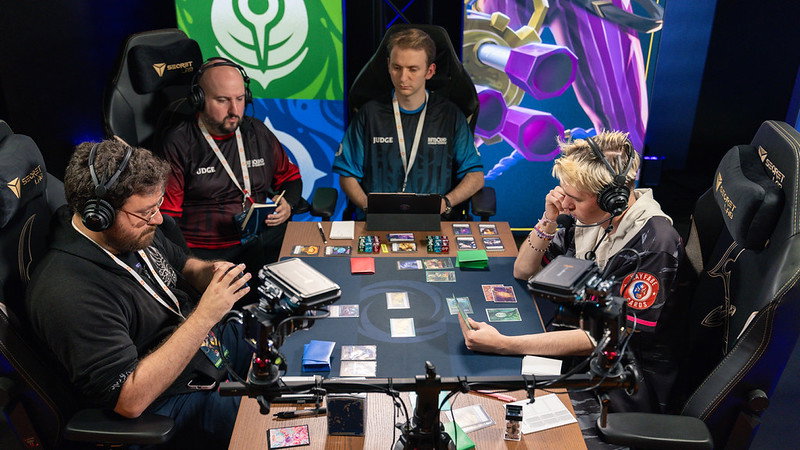
Factor and bsweitz face off in the first game of their finals match as Factor plays his Emperor’s Dais.
Amy: Are you planning to play a control deck in Set 4?
FACTOR: I haven’t looked much at what I’m gonna play. I like to see all the cards and then make a decision. A lot of times I will do this thing where I’m like, “I’m so excited for this deck,” and I’ll play it and be like, “Oh, I don’t really like this deck,” and end up playing the deck I’m not excited for. That ends up happening a lot. So I’ll probably just test out a bit of everything and see what I enjoy the most. I do prefer the control playstyle, so it ends up being where I end up a lot. But both the events that I’ve done well at I have not been playing control, so maybe I should lean a little bit more away from it.
Playing a multitude of every deck has been one of the reasons why I am as good as I am. I decided to play Yi Thursday night before the event and pick up the deck then. Because I have so much knowledge about the game, it ended up being successful enough for me, even though I didn’t get to get a lot of reps into it.
AMY: Many decks have positively evolved in between sets because people have more choices.
FACTOR: It’s really cool seeing how the different decks— now that we have three sets out—can build. We haven’t had Diana in previous sets, but even just throughout this set, you can see the list that Alanzq used to win Vancouver and compare it to my opponent’s list that I played against in Hartford finals. They’re doing so many different things even in the same color combos, even with the same 25-30 cards. Those extra 5-10 different cards that are in the deck can change what it’s doing and what it wants to do, which is cool, especially playing 40-card decks.
I played One Piece and Magic the Gathering and Pokémon before, and the deck size is a lot larger, so it’s harder to see some of the cards that you want to see sometimes. The 40-card deck size makes the deck building interesting and allows for, as we get more sets, the same leader to be played in a multitude of ways. You can even see it with Rengar. There was a list that got 27th at the event. That list was playing a different champion unit than the one that got the Best Of. The card design and space for Legends to be played in different ways is really cool.
AMY: What is your competitive background with TCGs? How does that influence the way you prepare?
FACTOR: Both my dads played on the Pro Tour for a long time. They both played poker professionally for a bit as well. So I’ve been very immersed in cards basically since I was born. As a kid I decided I liked playing video games more, so I played a lot, and there have been multiple video games where I’ve hit #1 in the world on leaderboards.
One was a game called Knockout City that came out in 2021. Another is a mobile game made by Supercell called Brawl Stars. That’s the most popular one. I was so mad because I was 15 at the time, and you couldn’t play high-tier tournaments unless you were 16. I hit #1 in NA when ranked released and was like, “I’m bored. There’s not much more for me to do.” I’ve only been playing TCGs competitively for a couple years now. I played One Piece TCG and did a couple regionals.
As far as Pokémon, I haven’t been as successful as I have been in Riftbound, but I learned mostly that the mental game is really everything. I strive to make sure that I’m having fun when I’m playing. Even going into Top 8, I was like, “I get to play more Riftbound. This is the best thing that could happen to me, right?” I remember after Vancouver Regionals, we finished Day 2, went back to the Airbnb, and played to 3 a.m. We were like, “We get to play more Riftbound!”
I learned a lot as a kid being in such competitive spaces, how important the mental is and to also have the mindset that you’re playing to learn. A lot of the times when I’m testing with my friends, we make sure that it doesn’t matter who wins and who loses when I’m testing with my partner. We are just playing to figure out the best lines and to better each other. That’s something that we’ve been working on in our team as well.
AMY: In your team, do you pair off into partners?
FACTOR: Normally we all play against each other. There are only six of us that test a lot together. So we shuffle around based on just who’s available that day. We all have vastly different schedules, and three of us work at the same store, so we have different days off. We end up playing a lot of times where there’s 2-4 of us available, and we’ll shuffle down between those people.
My teammate Ricky and I have played the same deck list every event since Atlanta. Atlanta, Vancouver, and now Hartford. We very much believe that if we’re not playing the same list, then we did something wrong in testing. If we have differing opinions, then there’s something that one of us is doing incorrectly. We put a lot of faith in each other. We’ll make decisions the night before where one of us will be like, “I think we should do this,” and the other will be like, “Ah, I don’t know.” But we fully trust each other to make those decisions and understand the game at a level, and that’s helped a lot with us doing as well at events as we have been.
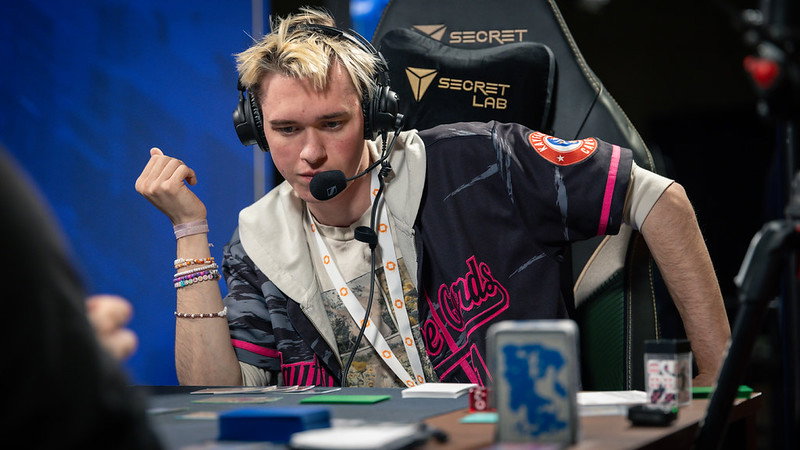
Factor thinks about his next play.
AMY: That’s an advanced approach that takes skill and trust, seeing as many people keep their decks secret. They don’t necessarily try to run the same one as their friends, whereas on the pro level you see that more.
FACTOR: I’m not good at keeping secrets. I’m a very open book. If somebody asks me things, I’ll talk about it. Even after winning the event, so many people asked me questions about the deck, and I was like, “This is why I did all these things.” There’s not much of a reason to keep it secret.
I’ll have a little fun sometimes. I remember before the Pre-RQ, I made a post because we were playing the Fiora to be good in the mirror. I took a little picture of Master Yi with three White Flame Protectors, and I was like, “We figured out how to break the mirror.” And I wasn’t talking about White Flame Protector, but there were three of them in the photo. So I’ll do funny things like that sometimes. But most of the times I’m an open book on why I think things are good, and that’s just the best way to advance the game to the highest level.
AMY: Is your team remote or in person?
FACTOR: We all live in Salt Lake City. There’s five of us that have competed on the national level. Me, Ethan, and Ricky play a lot. We proxied Chinese decks back in September before the game came out and when they were having regionals. My two friends Taylor and Caitlyn work with me at the card store I manage, and they love playing and testing with us. It’s a lot of fun.
For a while Salt Lake City had the most game stores per capita. Trading card games in general here are huge. Wherever you’re standing, there’s almost always a store within five minutes of you. We have a lot of good Pokémon players and multiple regional winners that have come out of Salt Lake City. Overall it’s a big scene, and that helps, having so many people in the community. It makes playing more enjoyable.
AMY: Is community a big factor in how you rose quickly in TCGs?
FACTOR: Community might even be the number one factor. I am only going to do something if I enjoy it, so the community is a big thing for me. My teammate Ricky and I met the very first week the game came out. We played at a Nexus Night against each other, and we were the only two that had been playing before the game had released. Back then we didn’t know each other at all. Then for a while we’d see each other occasionally, but it was not until Set 2 that we started playing a lot together. The community here and getting to meet these people that I end up competing with at the national level is awesome.
We’re doing a little celebration event tonight. I think we have 30+ people signed up already. We’re doing my celebration but also a Utah celebration for getting a Regional, and we’re giving away my exact deck list and a lot of cool stuff. I’m excited.
AMY: In an interview you mentioned siding out two Lonely Poros to make room for Disarming Rake or another Challenge. In Game 2, are you usually planning to go second?
FACTOR: The reason I said Game 2 is because I won every Game 1 I played on the weekend, so I was always going second. I assume my opponent’s going to choose to go first most of the time. They have the choice on play or draw [in Game 2]. I assume that I’m going second, so I bring out Lonely Poro.
AMY: How do you factor in what you would mulligan and what you would need to draw?
FACTOR: Starting out I didn’t realize how complex mulliganing was. Then going into Houston, I made a lot of bad mulligan decisions at that event and didn’t do very well. Since then I’ve put a lot of time into working on making the correct mulligan decisions. A lot of the times, it’s matchup dependent. If I’m going second, for example, I would prioritize two-drops that have Might over two-drops that don’t. I would really want to find a Pit Rookie or even a First Mate or Fiora so that I can get over their unit instead of only wanting a Scuttle Crab. But if I’m going first, I really want a Scuttle Crab. I don’t need to have any Might to get over units.
There’s a lot of small things I think about as far as mulligans go. I try to prioritize cards that are going to be impactful on the first three turns of the game. If I don’t think I’m playing a card in the first three turns, I’m almost always mulliganing it. With how small decks are and most of my cards being three-of, if I’m like, “I’m not going to use you for a bit,” I just get it out of here. I’m probably going to draw a second one anyways because I’m going to see another ten cards.
En Garde is a big example. I don’t know if there was ever a time on the weekend that I kept an En Garde in my starting hand. The card itself is good, but I would most of the time rather that card be a Discipline or something that’s going to further me into my deck and draw me more cards.
AMY: You trust in your deck to pull the right cards and ramp later. Then, in your mulligan, you’re just holding cards that could be played on Turns 1 or 2?
FACTOR: Yeah. I heavily prioritize the early game, and I expect to draw into my later game. Of course, in some matchups, that’d be a little different. If I’m playing against a removal-heavy deck, if I have a camel, I’ll always keep the camel. But anything else, I would just get it out.
If I’m playing against a deck where I’m like, “I really want Rengar,” I would keep the Rengar. But a lot of the times I would mulligan the Rengar because I’ll probably see a second Rengar. There’s a lot of times when it can be hard to play two of that card. Sometimes it can be really good when you play two of it, right? But not always.
AMY: Did you struggle with any of your mulligan decisions in RQ Hartford?
FACTOR: The mulligan decision I struggled with the most was when I hit Sam Sherman on Rengar. I struggled a little making the correct decisions. I think that’s why I lost our series.
I hit a Lux deck, so obviously I assumed they are on infinite combo, but they could be on control Lux still. So I made decisions hoping that they were on infinite combo, which ended up working out for me. Going into our match against Rosum, I knew that he was going to be on some control-type Baron already. I talked to him a lot on the weekend. I even talked to him in Vancouver about Pyke because we were both playing it, which allowed me to make better mulligan decisions. Most of the time I felt pretty confident about what I was mulliganing for and evaluating what was going to happen in Game 1. The deck’s very strong in Game 1 due to those three Sabotages being in the main board. They felt pretty good on the weekend. I made a lot of the right decisions.
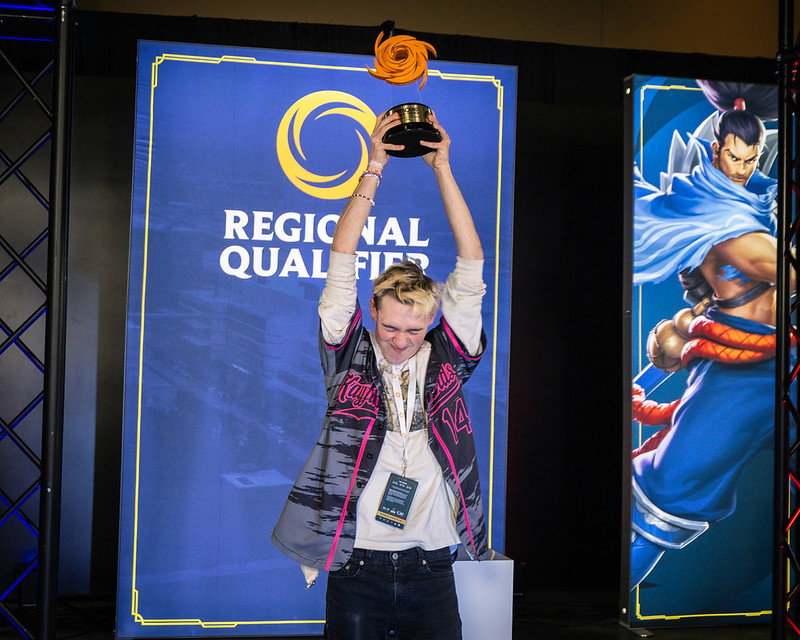
Factor lifts the Regional Qualifier: Hartford trophy after taking the victory in a 2-0 finals match.
AMY: You mentioned the mental game being so important, as it extends to wellness, mental health, and making sure you enjoy the game. ButRiftboundis also a mind game. Are there any tips or hot takes about the mind gaming that you think most players don’t know about?
FACTOR: Especially at the pro level, people don’t realize that the mind game starts the second you sit down at the table. Before any cards are placed, sitting down at the table, I would—especially in early rounds—make it a point to talk to my opponents about other events and see how they have done in other events to decide if I can make more greedy plays. Especially in a deck like Yi where I get to see my opponent’s entire hand. Sometimes you can see your opponent mess up. You’re like, “I know that these are the cards that you have, so I know that you could have done this line that you didn’t see.”
Sometimes, especially in the early rounds, I would be in a spot where I know that the game is lost. I’m like, “I can math out that these things are going to happen over the next two turns because I can see your hand.” But I would make a play that would try to force us into the most difficult line for them to find. This is a lot of mind games. Normally I feel good at reading what my opponent has and understanding, “Based on them making this play, they don’t have this [other card] in their hand.”
A great example is the finals game that I played against Ben. You’ll notice in Game 1 he made a Ride the Wind play where he rode his 3 Fizz into my 2 Lonely Poro. He made a really good read that I didn’t have a buff spell in my hand because there were times early in the game where if I had a buff spell I would have played it. Unfortunately, I had Primal Strength, which was unplayable before because of the Hard Bargain. He made a solid read that backfired.
Really look at the game as a whole and think, not even about what you’re doing, but about what your opponent has done and what cards they play in their deck. If they had a more optimal way, for example, if they kept up two mana, you went in, and they only played En Garde and not Discipline, then you can understand that they probably don’t have a Discipline in their hand. There’s a lot of small things to think about that can give you edge percentage points. It’s all those points that lead to doing well at events. A lot of people will be like, “There is a lot of luck involved,” but getting every little percentage point you can is important throughout matches.
AMY: How do you get better at reading someone?
FACTOR: The biggest thing is in testing. We’ll do this thing where we’ll testing, and I’ll literally be like, “I think these are the exact four cards you have in hand.” Sometimes I’ll be right, and sometimes I’ll be wrong. Doing those little exercises when you’re playing with your friends, if you’re really trying to test and improve, talk about, “I think that you have these cards because of these reasons.” You can even talk that through with your friend or opponent that you’re playing with. We’re working on those mental exercises, in the casual space, trying to understand exactly what your opponent could have. The more that you do that, the better you’ll get at understanding how to read your opponent and what they could be playing.
AMY: With those skills, is a good deck winnable against any matchup? Or are there certain matchups that you would not be able to beat?
FACTOR: In TCGs, every matchup is winnable. I don’t think there’s ever a full unwinnable matchup. A lot of times people will look at matchup spreads and be like, “This matchup is really bad for me.” Let’s say it’s a 25% win rate, and they have to get really lucky. They’ll see those numbers and be like, “Because of that, I’m not going to test the matchup because I’m going to probably lose anyways.” Whereas I think those numbers start getting inflated when people see the numbers, and they don’t test the matchup. Then it gets worse and worse because they’re not testing it.
A lot of the times these bad matchups can be solved. There’s never a solution to card games. When I’m testing, I would spend much more time testing my bad matchup than my good matchup. If I have a matchup that’s 30%, I’m like, “I want to figure out how to bring that 30% to a 40%.” Because I hate the mindset of, “I’m going to try to dodge it on the weekend.” Especially playing sixteen rounds of Riftbound. The chance I hit a bad matchup is high, and the chance that other pros doing well are also hitting bad matchups is high. The mindset of, “I’m going to dodge it,” is not very good. People just need to be okay with losing and going into these bad matchups and testing them as much as possible to bring the edge from 30% to 35% or 35% to 40%. People are really scared to do that. Of course, people don’t like losing, but people undertest the bad matchup because they just assume it’s bad.
AMY: What separates pro-level TCG players and people who are less experienced?
FACTOR: It’s a bit of everything. Most pros that I’ve talked to and interacted with, we all have our own strengths and weaknesses, but we’re all very good at every aspect of the game and understanding how to get all the little edges and percentage points that we can going into matchups.
The biggest thing that I always see is mindset. I know players who, especially people who aren’t pro yet that think they’re really good, they will lose a round early and get really upset. Maybe something unlucky happened because sometimes you do just lose. Then from there, it’s hard for them to bounce back and bring the event back up. Dhawally lost his Round 2 match in Hartford, and even after losing still ended up in Top 8. He won every match after that and didn’t let it get to his head after losing one early round.
AMY: Is there one card that you would ban?
FACTOR: I would be sad about it because I love it, but if I could choose to ban a card, it would be Arena’s Greatest. I do think that card is turbo broken. It’s polarizing going first and playing Arena’s Greatest while your opponent plays some battlefield with text, so you now get to use their battlefield first because you went first. Then they don’t have a battlefield with text to use.
It also leads to missed triggers. In Top 8 of Houston, somebody missed their Arena’s Greatest trigger and lost the game. There was a lot of discourse in the middle of the event. I think the card has created unnecessary drama and discourse during events, as well as just being a broken battlefield. I’m surprised it survived the bans. I know at the time it wasn’t super oppressive, but it’s an incredible card.
AMY: I noticed you’re a big Gracie Abrams fan. What music are you currently excited about?
FACTOR: A new Gracie Abrams song just came out last night called “Look at My Life,” so go listen to it, everybody! I listen to a lot of pop, girly music, like Gracie Abrams, Sabrina Carpenter, Taylor Swift, but not as much anymore as I did in the past. My favorite artist is named Maisie Peters. She’s a smaller artist out of the UK. If you see me playing at events, I have a Maisie Peters playmat that I use at all my events. If you played against me, you’ve probably seen it before. I love stuff like that—Madison Beer and that vein of music. I travel to go to concerts. I’ve been VIP, and I have a bunch of lanyards on my wall.
AMY: I’m going to a Kacey Musgraves concert soon.
FACTOR: Oh yeah, I’m going. I’m seeing her when she comes to Salt Lake in October. My stepmom is a big fan of her, so I’m excited to go to that one.
AMY: There’s just something nice about how her music straddles pop and country.
FACTOR: She did a really good job of that in-between.
AMY: Do you have a favoriteLeague of Legendscharacter that you would love to play?
FACTOR: As far as League, the only champion I play is Zac. I literally will five-stack with my friends and I’m like, “I will play support, mid, top, or bottom—I don’t care—but I will be playing Zac.” As long as you don’t give me ADC, I can play Zac in any of the other four roles. He’s the only champion I play. I love playing Zac. I probably have hundreds of games on Zac in the last five years and maybe 10-15 non-Zac games in total. It’s my go-to. If he ever comes out, I will be battling for that Best Of.
AMY: So even if his deck is bad, you’ll still be—
FACTOR: Give me the worst deck. His leader effect can be, “You need 20 points to win.” I still play it. I still battle. Let’s go.
AMY: I seriously hope they make Zac cool for your sake.
FACTOR: One day, one day.
Editor’s Note: Factor’s deck is based off TSS housesarebig’s originalMaster Yi, Wuju Bladesman guide. They plan to update the housesarebig guide with Factor’s build soon.

 Fizz into my 2